AI software embedded in video devices, wearables and sensors—not to mention actual patient monitors—can continuously track post-surgery patients in real time, sending predictive insights to care teams regardless of where they’re stationed.
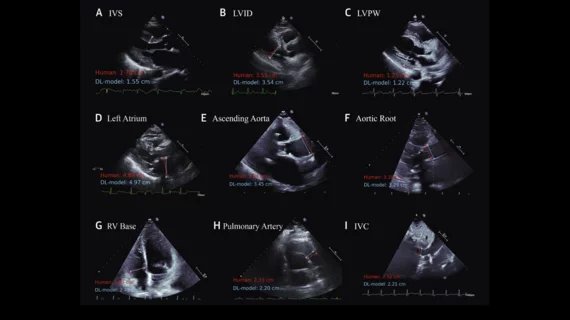
A comparison of measurements made by a sonographer (in red) and predictions from the deep learning model (in light blue) across 9 echocardiographic parameters. Image and caption courtesy of Ouyang et al., JACC.
The algorithm, trained on more than 150,000 TTE studies, can calculate 18 different measurements regularly used in echocardiography
People with substance use disorders stand to benefit from healthcare AI just like any other patients. But they may have to wait a bit longer than most others since AI has only just begun to emerge in addiction medicine.
AI could appreciably improve the delivery of healthcare services to patients—if only people trusted it. For many, the difference-maker would be nicely crafted federal regulations.
It’s too soon to characterize the economic impact of AI across Western healthcare with anything more than rough guesstimates. This is so for two reasons.
Many Gen Z-ers pursuing careers in healthcare to avoid AI-related workforce shrinkage will learn a hard lesson: Job security and job satisfaction are two very different things.
There’s no shortage of technically impressive AI applications for primary care. Yet these tools tend to lag well behind AI models aimed at clinical specialties when it comes to integration into routine practice.
A new analysis published in Artificial Intelligence in Medicine argues that education tools are failing to show clinicians how to make use of new technologies, calling into question the benefit of rapid adoption.