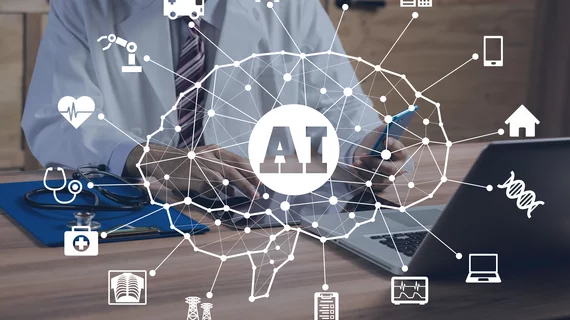
AI in healthcare has long been touted as an innovative technology that will accelerate care treatments and even replace some tasks performed by clinicians. But its impact might be inequitable in the future.
Cerner, a global health platform, has teamed up with Amazon Web Services, a subsidiary of Amazon that offer cloud computing platforms, to accelerate healthcare solutions and AI in healthcare.
Allowing natural language processing to pore over disparate data stored in electronic health records, researchers in Canada have shown the AI-based technology can reveal real-world experiences and outcomes of patients with stage III breast cancer.
An AI company owned by Google parent company Alphabet, DeepMind, is able to predict future acute kidney injuries and could potentially save lives, according to a new paper published in Nature.
NIH funding opportunities remain numerous for innovators who apply evidence-based medical science to their proposals for smartphone apps, and the agency isn’t hesitant to get behind AI-based approaches.
A Harvard-affiliated academic data science center is partnering with a major manufacturer of portable ultrasound systems to boost the diagnostic powers of point-of-care ultrasound, aka “POCUS,” using AI.
Not only is AI aiding recovery for some of the sickest hospitalized patients—those in the ICU—but it’s also making work less stressful for the medical professionals who care for them.
In the wake of Alexa’s success at gaining HIPAA-compliant medical skills, AI developers are working to offer smart speakers that do everything from warning homebound people they’re having a heart attack to taking clinical notes for physicians during patient visits.
AI and deep learning can extract molecular markets of breast cancer from tissue morphology and assist pathologists in a mass-scale molecular profiling, according to new research published in JAMA Network Open.