 | ● |  |
|
|
|
| | | AI news you ought to know about: - The numbers from Pittsburgh are staggering. And they’re all about blasting American-made AI into the stratosphere, if not to Infinity and beyond. Investments in the billions will be pouring in from at least 15 tech and energy companies and in the mere millions from five or six others. The pledgers are led by Google and the private equity firm Blackstone. Those two alone said they’re good for $50 billion—$25 billion apiece. All told, some $92B is set to pour into Western Pennsylvania, much of it to fuel energy production and infrastructure development. If those kinds of bucks flow in as promised—or rise to top $100B—Pittsburgh will become an AI hub of formidable power. (Bay area bigshots, eat your hearts out?)
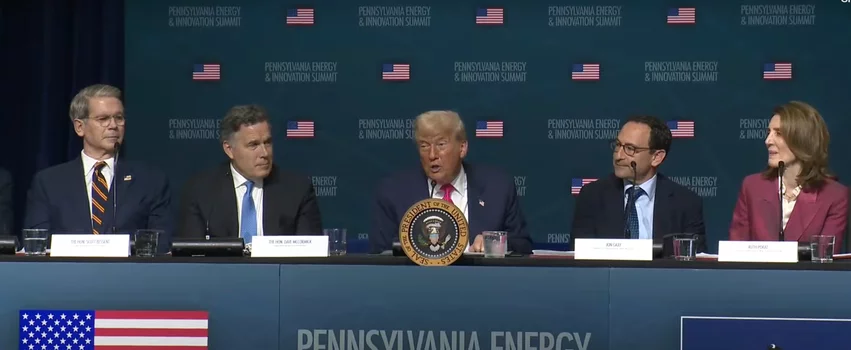
- This sits well with the “special guest” of the event at which the plans were announced. “Today’s commitments are ensuring that the future is going to be designed, built and made right here in Pennsylvania and right here in Pittsburgh,” President Donald J. Trump said at the inaugural Pennsylvania Energy and Innovation Summit held July 15 at Carnegie Mellon University. “And I have to say, right here in the United States of America.”
- Meanwhile the summit organizer, Pennsylvania GOP Senator Dave McCormick—a Capitol Hill freshman—struck a note of bipartisan victory. Addressing the Keystone State’s Democratic Governor, Josh Shapiro, McCormick said, “We’re different parties and have plenty of differences, but on this we agree: We need to be at the crossroads of the energy and AI revolution.” He then wasted no time posting the investment commitments in writing.
- Environmentalists aren’t thrilled with the development, as the energy companies ponying up are mostly focused on fossil fuels. “This is exactly the wrong direction on energy at this critical time,” said Sandy Field, PhD, chair of the Climate Reality Project’s Susquehanna Valley chapter. “Pennsylvania has a chance to pivot right now and lead on the renewable energy transition that we need to fight the climate crisis. This meeting is just about planning more fracking projects and asking Pennsylvanians to sacrifice our health and the environment yet again.” Other leading environmental activists voiced similar concerns.
- Interior Secretary Doug Burgum shrugged off such apprehensions, suggesting they demand less urgency than other priorities. “I mean, really, this administration had identified early that there are two existential threats, and neither one of them is climate change,” Burgum said at the summit. “One is Iran getting a nuclear weapon. And then two is losing the AI arms race.”
- Two Bay area metro centers are AI superstars. This means they excel in all three AI “success pillars”—talent, innovation and adoption. The neighbors and high performers are San Francisco and San Jose, and they’re alone among all U.S. cities making the superstar grade in the eyes of the D.C.-based Brookings Institution. Another 28 aren’t all that far behind, earning the title “star hubs” from Brookings for maintaining “uniformly strong AI ecosystems” and balancing top-tier talent with research and enterprise uptake. However, metro centers in lower echelons of advancement to this point are coming on strong of late. “[T]he recent boom in generative AI and agentic systems is beginning to widen the geography of AI activity to a broader set of emerging metro areas,” Brookings analysts comment. “To fully harness the power of AI, the U.S. should combine supportive national strategy with bottom-up economic development by regions.” It’s all in a detailed report released July 16, “Mapping the AI economy: Which regions are ready for the next technology leap?” After Pittsburgh and environs, we can now say.
- Close to 80% of American adults are likely to tug the virtual sleeve of Dr. Google when they feel symptomatic of illness or injury. Of those, 75% say AI-generated information is helpful “often” (31%) or at least “sometimes” (45%). The findings are from a survey of 1,600 individuals conducted in April by the Annenberg Public Policy Center at the University of Pennsylvania. Consumers’ growing reliance on AI deserves attention, the surveyors caution. “Although Google notes that its AI summaries may not be accurate, vast numbers of Americans are exposed to these answers and most consider them reliable,” Annenberg researchers comment. One emphasizes that AI platforms “are not necessarily updated in real time and may contain outdated information. Skepticism is warranted.” More findings here.
- The closer a hospital is to a city center, the more likely it is to use AI across all use cases. These include automating tasks, optimizing clinical work, predicting patient demand, predicting staffing needs and scheduling staff. The observation is only logical, especially given the preponderance of well-resourced academic medical centers in urban areas. Still, it’s interesting to see a granular breakdown of the stats. A researcher at the Federal Reserve Bank of St. Louis leads a tour through the data in a July 15 blog post. She compares AI uptake in metro areas with that in “metro-adjacent” (primarily suburban) and “not-metro-adjacent” (mainly rural) locales. Her focus is on geographic predictors of AI’s impact on workforce issues. “AI has the potential to impact the healthcare workforce by optimizing operations and potentially addressing worker shortages and gaps in access to care,” writes the researcher, Nicole Summers-Gabr. “However, not all hospitals may have the infrastructure in staffing and technology to implement these systems; this may especially be the case for hospitals in more rural communities.”
- Is your healthcare system really good at providing care—or great at using AI to charm you into thinking so? It’s getting harder to tell. And it’s not like a provider organization can’t be both a top clinical performer and a slick self-promoter. A contributing writer at Forbes explains why. “AI enables precision-level advertising by analyzing user behavior, demographics and intent signals to deliver targeted ads,” writes Lauren Parr, co-founder and product director of a healthcare reputation-management platform called RepuGen. “Marketers can deliver highly targeted messages to the right audience at the right moment while retargeting campaigns reengage patients who have shown interest but haven’t yet converted.” Read the whole thing.
- The deeper the U.S. government dives into AI, the less secure we all are. At least it seems that way, what with all the calls we’re hearing of late for more and better cybersecurity. “With AI being embedded in so many of our tools and technologies, we are already finding that [federal] agencies are not able to really provide the additional protections for their data and our personally identifiable information,” Jennifer Franks, director of the Center for Enhanced Cybersecurity and acting director of the Analytics Foundry at the Government Accountability Office (GAO) said at a summit outside the nation’s capital July 10. “Going into the next phase of deploying and developing additional AI software tools and technologies, we’re finding more and more that federal agencies do not have the capabilities to really put us at the edge of where it is we need to go.” Gulp. Coverage of the summit by GovCIO Media is here.
- From AIin.Healthcare’s sibling outlets:
|
| | | |
| |
| | | | In hospital settings, the success of AI adoption hinges on how well implementation leaders balance technological innovation in departmental silos with operational nimbleness across the enterprise. In a term, the latter refers to hospital logistics. The observation is from researchers at the Fraunhofer Institute for Material Flow and Logistics in Dortmund, Germany. Their paper was published July 15 in the German journal Federal Health Gazette: Health Research/Health Protection (Bundesgesundheitsblatt: Gesundheitsforschung/Gesundheitsschutz). The work “contributes to understanding the potential and limitations of AI applications in hospital logistics and provides a systematic framework for their strategic implementation,” state the authors, Sylvia Kaczmarek, PhD, and Sebastian Wibbelin, PhD, both of whom are Fraunhofer engineering professors. The researchers walk the reader through a number of hospital settings in which AI-aided logistics are either already active or soon will be. Here are three. 1. Transport. In conventional autonomous transportation, robots with decentralized control mechanisms enable intelligent resource utilization through swarm-intelligence behaviors and optimized order scheduling, the authors explain. “These systems use machine learning algorithms to recognize patterns in data and make decisions in real time, which significantly increases the efficiency and speed of transportation (intelligent routing, avoidance of empty runs, use of available elevators, etc.).” More: ‘Transport robots with AI-enabled sensor boxes—which are currently in the development phase and take up the basic idea of innovative logistics approaches—go a step further. With them, autonomous vehicles can learn from human interventions during transport disruptions and predict similar situations in the future.’
2. Central warehouses and pharmacies.In warehouse logistics, AI can enable predictive planning approaches that take dynamic influencing factors into account, Kaczmarek and Wibbelin point out. “Furthermore, they offer flexible response options to unexpected events.” For example, the authors add, AI-supported systems can analyze historical data to predict future demand and adjust inventory levels, thereby improving resource availability. “In picking processes, AI can predict likely quantities per cost center, making the use of transportation resources more efficient.” More: ‘With the advancement of technology, AI-supported picking and transportation technology, especially autonomous robot systems, is expected to become increasingly established. These systems optimize material flow processes within various organizational units and contribute to increasing overall productivity.’
3. Nursing stations. In bed-based areas such as nursing and intensive care units, AI opens up innovative possibilities for optimizing material management and logistics processes, the authors note. “AI-supported analysis of material consumption data,” they write, “enables precise predictions for optimal storage and ordering quantities.” What’s more, the authors highlight, AI “offers the potential to automatically detect and document nursing activities through motion identification using sensors. This not only improves the traceability of care services but also relieves nursing staff of documentation tasks.” More: ‘Logistics processes in nursing stations can also be supported by autonomous robot systems. These systems can efficiently transport materials, medications and laboratory samples between different hospital areas—for example, between the intensive care unit and the laboratory.’
The paper is posted in full for free, albeit in German. AIin.Healthcare used OnlineDocTranslator.com to render the text in English. - In other research news:
- Funding:
|
| | | |
|
| |
|
|